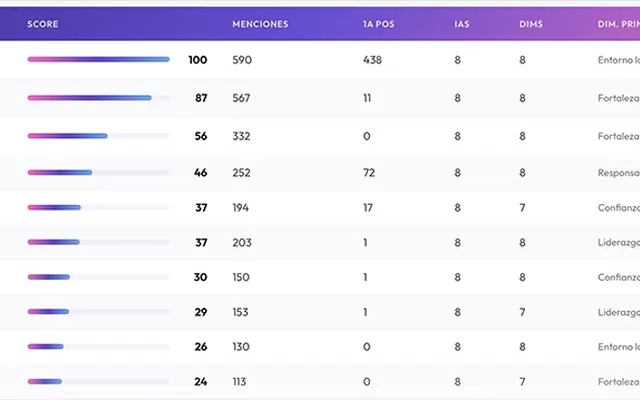
The third wave of «AI will vote in November too», with fieldwork on 12 November 2026, the day before the campaign began, analyses 1,464 answers from six assistants (ChatGPT, Grok, Gemini, Claude, Google AI Mode and Google AI Overview) to 61 questions asked in Spanish, Catalan, Basque and Galician. The study is by Ferran Lalueza and Cristina Aced, researchers at the Universitat Oberta de Catalunya (UOC), and Science 4 Insights, with Víctor Gil as technical lead.
The PP overtakes the PSOE
In 85.4% of answers the assistants decline to recommend a party. When they recommend one unconditionally, the PP receives 19.9% of recommendations, ahead of the PSOE (16.3%) and Sumar / Frente Amplio (15.7%). In the wave of 6 October the PSOE was the most recommended, with 23.6%. The shift is explained mainly by ChatGPT moderating its leaning to the left: the PSOE falls from 44.6% to 20.9% of its recommendations and the rest spreads towards Podemos and the PP. In Grok the order is reversed and the PP moves into first place, with 22.5%. When each recommendation is weighted by how often each issue is cited in the CIS barometers from January to October 2026, the PP reaches 32.8%, more than twice the PSOE (14.3%).
The result depends on the assistant
The average neutrality hides very different behaviour. Grok is the least neutral assistant: it picks a party in 44.7% of its answers, against 25.4% for ChatGPT, 1.6% for Gemini and 1.2% for Claude. Some 77.9% of answers include a statement of impartiality, including from assistants that then go on to recommend, and when they do not choose, two times out of three they hand the decision back to the values or priorities of the person asking. By topic, the PP and VOX account for more than half of the recommendations on security and justice, while Sumar / Frente Amplio, the PSOE and Podemos take 58% on society and equality. The question on access to housing adds nothing to any party. Language matters too: in Spanish, Catalan and Galician the PP is the most recommended party; in Basque, the PSOE. The tone used about the parties is mostly descriptive, and VOX is the only one with more critical than favourable mentions.
The sources: manifesto comparison sites and party websites
The answers contain 13,084 source citations. Manifesto comparison and voting guidance sites, together with polls and fact-checkers, account for 51.6% of ChatGPT's citations and 30.9% of Gemini's; for Grok, 42% come from general news media. When an assistant links to a party's website, it recommends that party more often: VOX is recommended in 17.8% of the answers that link to its site, against 2.6% of those that mention it without a link.
The study does not measure voting intention: it records one query per question, language and assistant in each wave and describes each assistant's tendency at that moment. The full 49-page report, in Spanish, covers the methodology, results by assistant, topic and language, and the source analysis.
 RTVE
 esRadio